
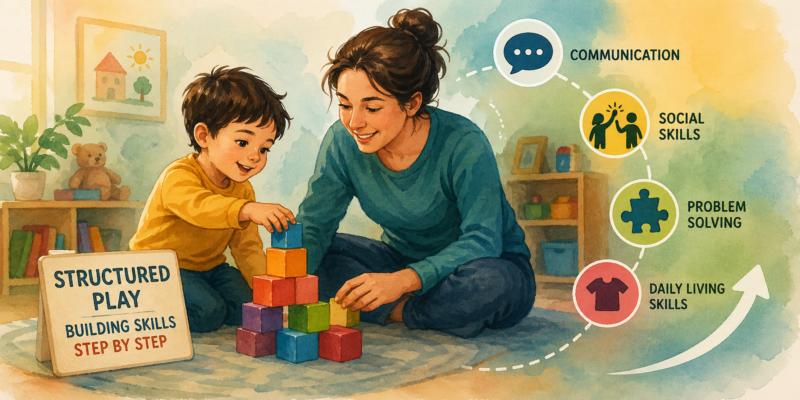
What Structured Play Actually Looks Like
Structured play doesn’t mean turning playtime into a boot camp with whistles and clipboards. It simply means there’s a clear purpose behind the activity, even if the child never notices. The adult sets up a situation where a specific skill is encouraged, practiced, and gently reinforced.Think of a simple game like rolling a ball back and forth. It sounds basic, but it teaches turn-taking, eye contact, anticipation, and coordination. Compare that to free play with a dozen toys scattered across the floor, where attention jumps from one thing to another like a browser with too many tabs open.
The difference is subtle but powerful. One approach hopes skills appear. The other quietly builds them.
Why Free Play Isn’t Always Enough
Free play often gets celebrated as the gold standard of childhood, and for good reason. It encourages creativity and independence. But for neurodivergent children, especially those working on communication or social interaction, it can sometimes feel like being handed a map with no landmarks.Without guidance, a child might default to repetitive behaviors or avoid interaction altogether. That’s not a failure; it’s simply what feels comfortable. The issue is that comfort zones rarely stretch skills on their own.
Structured play introduces just enough challenge to move things forward. It creates moments where a child is gently nudged to request, respond, or engage. No dramatic speeches required—just small, repeatable interactions that add up over time.
Simple Activities That Do Heavy Lifting
Parents don’t need specialized training or a suitcase full of equipment to make structured play work. Everyday items can become surprisingly effective tools when used with intention.- Sorting games with household objects to build categorization and focus
- Turn-taking games like stacking blocks to encourage patience and interaction
- Picture matching or simple puzzles to support problem-solving and communication
- “Request and receive” setups where a child asks for a toy before getting it
A child who learns to request a toy during play is quietly building a foundation for asking for help, expressing needs, and navigating social situations later on. It all starts with something as simple as “your turn” and “my turn,” repeated enough times to stick.
Balancing Fun With Purpose
There’s a common worry that structured play might drain the joy out of playtime. In reality, it’s less about control and more about direction. The goal isn’t to eliminate fun—it’s to make sure fun is doing something useful behind the scenes.Children still laugh, explore, and occasionally decide the rules no longer apply. That’s fine. Structured play isn’t about perfection. It’s about creating opportunities where learning can happen naturally, even if the game goes slightly off-script.
Sometimes “slightly off-script” means the carefully planned stacking game turns into a dramatic tower collapse repeated twelve times. That still counts. There’s physics involved. And patience. Plenty of patience.
Why Consistency Quietly Outperforms Intensity
It’s tempting to believe that bigger efforts lead to faster results. Longer sessions, more activities, higher expectations. In practice, steady repetition tends to do more work than occasional bursts of enthusiasm followed by long gaps.Structured play thrives on predictability. When a child knows what’s coming, they’re more likely to participate and less likely to feel overwhelmed. Familiar routines reduce the mental load, leaving more room to focus on the skill itself.
Short, frequent sessions often outperform longer, irregular ones. Ten minutes of focused interaction every day builds far more than an hour once a week. It also fits into real life without requiring a complete schedule overhaul.
This is where many caregivers accidentally set themselves up for frustration. The expectation becomes “do more,” when the more effective approach is often “do a little, consistently.” It’s less dramatic, but far more sustainable.
Reading Progress in Small Wins
Progress in structured play doesn’t usually arrive with fanfare. It shows up in subtle ways—a longer moment of eye contact, a quicker response, a spontaneous attempt to communicate. These shifts are easy to miss if the expectation is immediate transformation.Paying attention to these small changes matters. They signal that the child is beginning to connect actions with outcomes. That connection is the backbone of learning.
There’s also a quiet confidence that builds when a child experiences success repeatedly. Completing a simple task, understanding a routine, or successfully interacting during play creates a sense of predictability. Predictability reduces anxiety, and reduced anxiety opens the door to more engagement.
It’s not flashy progress, but it’s durable.
When Structure Bends Without Breaking
Rigid plans rarely survive contact with real life, especially when children are involved. Structured play works best when it’s flexible enough to adapt without losing its purpose.If a child loses interest, the activity can shift while keeping the same goal. A turn-taking game with blocks can become a turn-taking game with toy cars. The skill stays the same; the wrapper changes.
This flexibility keeps engagement high without sacrificing direction. It also prevents playtime from turning into a negotiation marathon where everyone leaves slightly confused and mildly tired.
The aim isn’t perfect execution. It’s maintaining just enough structure to guide learning while allowing enough freedom to keep things enjoyable.
Play Smarter Not Louder
Structured play doesn’t demand elaborate setups or constant energy. It asks for intention, repetition, and a willingness to focus on small, meaningful interactions. That’s where the real skill-building happens.Free play will always have value. It sparks imagination and offers space to explore. But when the goal is developing communication, social awareness, and practical skills, leaving everything to chance is a bit like expecting a garden to grow without planting anything.
A little structure plants the seeds. Consistency helps them grow. And before long, those small, guided moments start turning into real, lasting abilities—even if the journey includes a few dramatic block tower collapses along the way.
Article kindly provided by thetreetop.com