
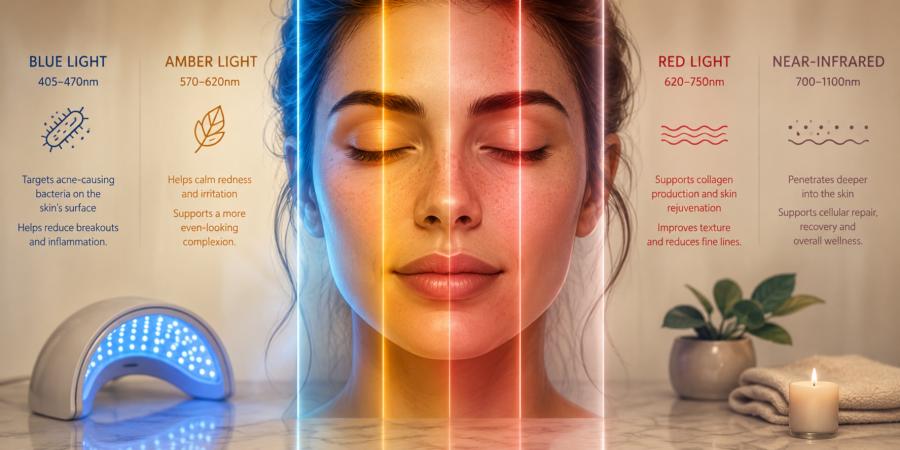
Light-based skincare has become a crowded neighborhood filled with glowing masks, handheld gadgets, and promises that occasionally sound as if they were approved by a committee of overexcited fireflies. Yet beneath the marketing sparkle sits a legitimate area of science. Different wavelengths of light interact with skin in distinct ways, and understanding those differences helps separate biology from wishful thinking.
Human skin is not merely a passive surface waiting for expensive creams to arrive. It is a responsive organ packed with cells, blood vessels, pigments, and proteins. Light reaches these structures at varying depths depending on its wavelength. Some wavelengths remain closer to the surface, while others travel deeper into tissue. That depth matters because different skin concerns involve different layers.
Why Wavelengths Matter
Light is measured in nanometers, a wonderfully tiny unit that makes millimeters look enormous and patient. The wavelength determines both the color visible to the eye and how deeply that light may penetrate skin.Not every glowing device deserves applause simply because it lights up dramatically in a dark bathroom. Skin cells respond to specific wavelengths more than to vague brightness. This is why discussions about light therapy usually focus on colors such as blue, amber, red, and near-infrared.
Researchers often refer to this process as photobiomodulation when light influences cellular activity. The term sounds intimidating, but the basic idea is straightforward: certain wavelengths may encourage biological responses without heating or damaging tissue in the way more aggressive procedures can.
Blue Light and Acne Battles
Blue light, commonly ranging around 405 to 470 nanometers, stays relatively close to the skin’s surface. Its reputation is tied mainly to acne management.Acne involves several factors, including excess oil, clogged pores, inflammation, and bacteria. One bacterium associated with acne, Cutibacterium acnes, produces compounds called porphyrins. When exposed to certain blue wavelengths, these compounds may trigger reactions that reduce bacterial activity.
This does not mean blue light behaves like a tiny superhero wearing a cape and issuing pore-related ultimatums. Acne is complicated. Hormones, skincare habits, genetics, and inflammation still play major roles. However, studies suggest blue light may help reduce mild to moderate breakouts when used consistently and appropriately.
Some users notice improvement gradually rather than overnight. Skin biology rarely responds to impatience, no matter how persuasive the impatience may be.
Amber Light and Calmer Complexions
Amber light occupies a middle ground, usually around 570 to 620 nanometers. It receives less attention than red or blue light, perhaps because it lacks dramatic branding and sounds suspiciously like something found in an antique necklace.Its interest lies largely in supporting skin that appears irritated or flushed. Some research suggests amber wavelengths may help calm visible redness and support circulation near the skin’s surface. For people dealing with uneven tone or temporary redness, this wavelength attracts attention because it aims at comfort rather than dramatic transformation.
This matters because inflammation sits behind many common skin complaints. Redness is not always a cosmetic nuisance; it can signal that the skin barrier feels stressed or overwhelmed. A calmer appearance often reflects improved skin balance rather than cosmetic camouflage alone.
Amber light should not be viewed as a cure for medical conditions. Persistent redness, rosacea, or inflammatory skin disorders deserve professional evaluation. Devices and treatments may support skin care, but they do not replace diagnosis or proper medical guidance.
Red Light and Collagen Conversations
Red light generally ranges between 620 and 750 nanometers and penetrates more deeply than blue light. This wavelength is frequently linked with collagen support and skin rejuvenation.Collagen is a structural protein responsible for helping skin maintain firmness and resilience. Over time, collagen production slows. Skin becomes thinner, lines become more noticeable, and mirrors begin offering opinions nobody requested.
Red light is thought to interact with mitochondria, the structures responsible for cellular energy production. One proposed mechanism involves the stimulation of cytochrome c oxidase, which may influence cellular repair and activity. Increased energy availability could support processes involved in healing and collagen maintenance.
Scientific studies show promising findings regarding texture, fine lines, and overall skin appearance. Yet expectations need proportion. Red light may support skin function over time, but it does not operate with the urgency of a reality-show makeover reveal.
Consistency matters more than spectacle. Many protocols involve repeated sessions over weeks rather than dramatic one-time results.
Near-Infrared and Deeper Reach
Near-infrared light, usually spanning roughly 700 to 1100 nanometers, moves beyond visible red light and penetrates more deeply into tissue.Unlike blue or amber light, near-infrared cannot be seen with the naked eye. The device may appear inactive even while working, which has startled more than one first-time user who expected a miniature sunrise.
Researchers explore near-infrared for recovery, inflammation support, and tissue repair because of its deeper penetration. In skincare discussions, it is often paired with red light to support broader cellular activity.
Evidence remains an evolving field. Some claims surrounding near-infrared are supported by promising studies, while others sprint far ahead of available data. This gap between evidence and enthusiasm explains why reading specifications and understanding wavelengths matters so much.
Bright Ideas Without the Glare
Light-based skincare is neither miracle nor myth. Different wavelengths interact with skin differently, and those differences form the scientific foundation behind many treatments.Blue light is associated with acne management near the skin’s surface. Amber light may support calmer-looking skin and reduced visible redness. Red light attracts interest for collagen support and rejuvenation, while near-infrared explores deeper biological responses.
The most useful approach is refreshingly unglamorous: examine the wavelength, understand the intended purpose, and maintain realistic expectations. Good skincare science rarely shouts. It tends to glow quietly while evidence does the talking.
Article kindly provided by aurasweden.us